The Reality of the Dollar — AXIOM Education Series Book 13
LEVEL 5 · WHAT MOVES MARKETS · BOOK 13
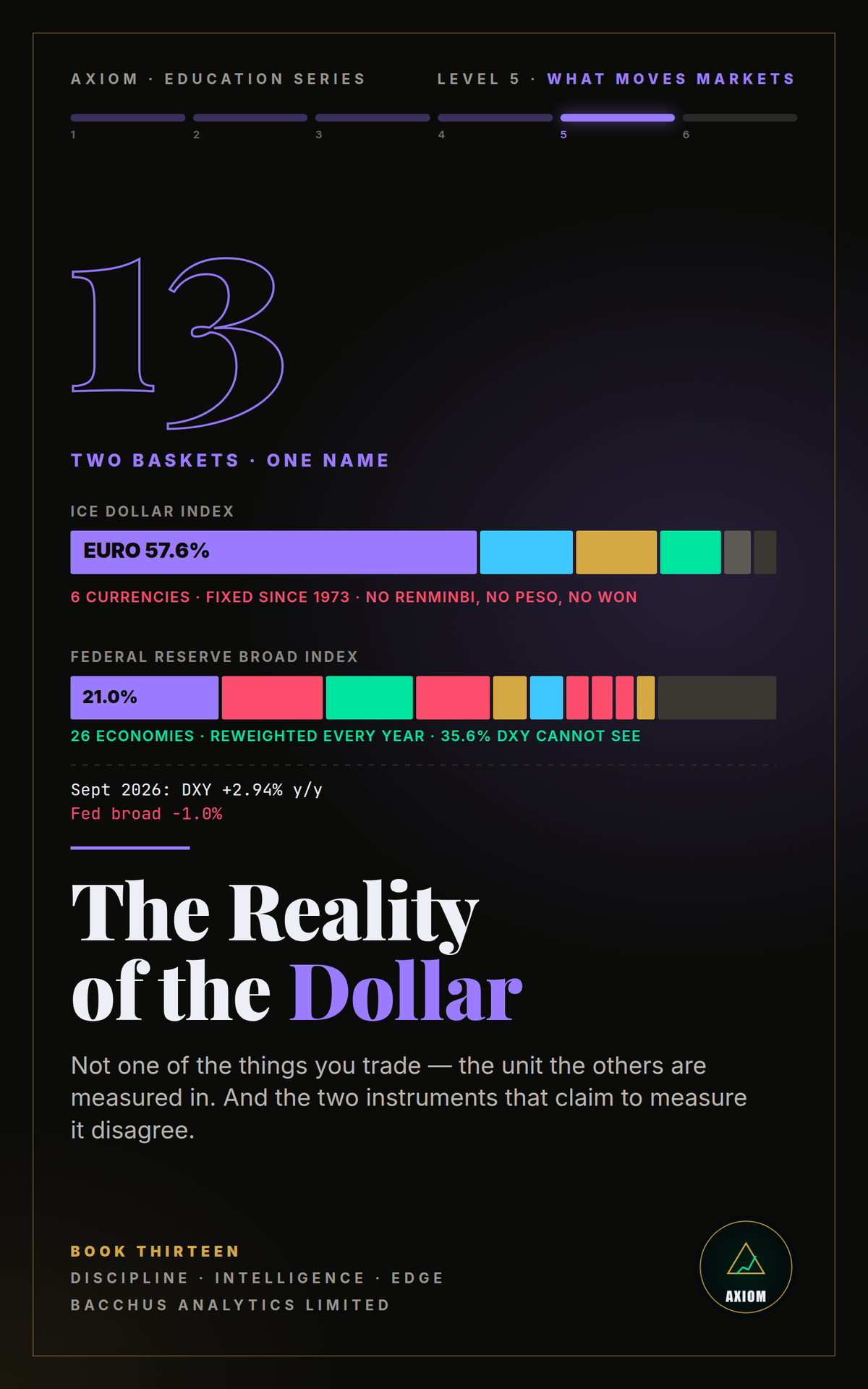
As this book went to press, the two instruments that both claim to measure the US dollar were moving in opposite directions. The ICE Dollar Index was up 2.94% year on year. The Federal Reserve's broad dollar index was down 1.0%.
Neither is wrong. They are answering different questions — and almost nobody trading a dollar pair knows which question they asked.
The dollar is not one of the things you trade. It is the unit the other things are measured in — so half of every move you see in a dollar pair belongs to the ruler, not to the thing being measured.
- Nine trades in ten — the dollar sits on one side of 89.2% of a $9.6 trillion-a-day market. It is in your book whether you chose it or not, and four charts with a dollar on them are not four decisions
- What your platform calls "the dollar" is 57.6% a euro position — and 77.3% European across six currencies, on a basket whose composition dates from 1973. To shift it as much as a 1% euro move does, the Swiss franc would have to move 16%
- There is no renminbi, peso or won in it — while 35.6% of the Federal Reserve's trade-weighted dollar sits in exactly those currencies. Two baskets, one name, reweighted on completely different schedules
- One event, two readings — a 1.00% euro fall with nothing else moving is +0.576% on one index and +0.210% on the other. The "worst first half since 1973" headline of 2025 was −10.8% on one and −5.5% on the other
- The bill under the privilege — $40.09 trillion of debt, crossed on 18 August 2026, the most recent trillion added in 154 days. Net interest has now passed national defense by $140.8bn. And why the same debt is honestly quoted at both 101% and 126% of GDP
- The strangest number in public finance — 8,133 tonnes of gold carried at $11.04bn on the books and worth $1.146tn at market, 103.8×. Revalue the lot and it covers eight weeks of federal spending
- Drift, not cliff — the dollar's reserve share has fallen about thirteen points since 2001, and what it lost went to gold, not to a rival. The renminbi settles about one international payment in thirty
- What actually moves it — rate expectations explain somewhere between a tenth and a fifth of dollar variation. In one Federal Reserve study they predicted 3.7 points of a 20.3-point rally
- The safe-haven claim, re-examined — the dollar is a funding-stress haven, not a general one. On an ordinary risk-off day the evidence says the yen and the franc do better
Every number in this book was re-derived from its primary source — Treasury, CBO, IMF, BIS, ICE, the Federal Reserve and the ECB — and each is labelled confirmed, reported or disputed at the point of use. Appendix A rebuilds the Dollar Index in six spreadsheet cells and reproduces the published index exactly.
Twelve chapters in four parts, four appendices, eight full-colour diagrams. Assumes Books 1 to 12.
Honest note: nine widely repeated dollar statistics did not survive the source check and are corrected in Appendix C; three were dropped entirely, including one that would have made a better story. Chapter 11 reports what forty years of research says about forecasting the dollar from this material, which is less than you would like. A book that left that out would be easier to sell and worse to own.
Instant PDF download, 117 pages, in colour, readable on phone, tablet or desktop.
Educational purposes only, not trading or financial advice. It is not a forecast of the dollar's value. Most retail CFD accounts lose money; trading leveraged products carries a high risk of losing your money.