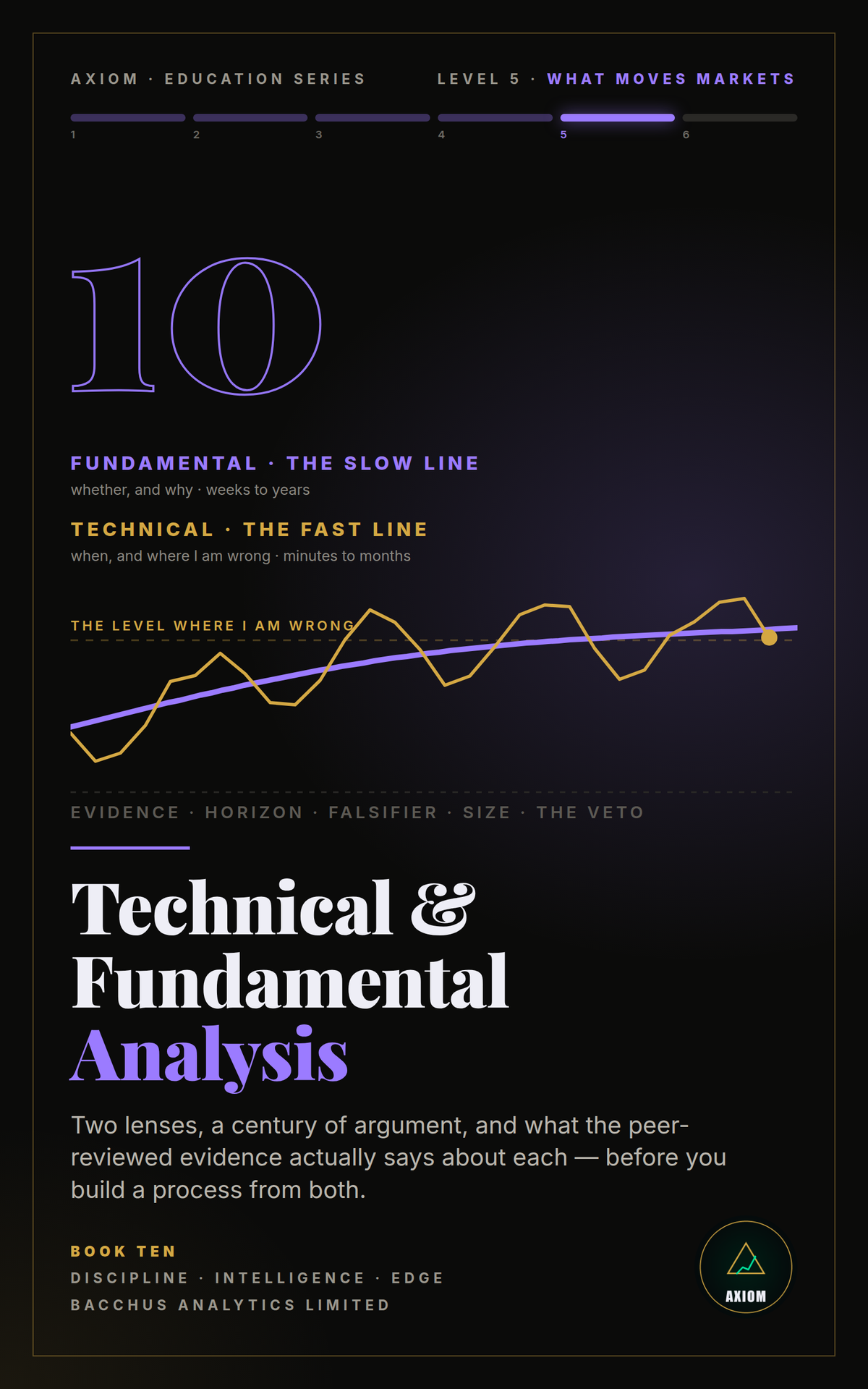
Technical & Fundamental Analysis — AXIOM Education Series Book 10
LEVEL 5 · WHAT MOVES MARKETS · BOOK 10
Level 4 was about the trader. Level 5 is about the market — and this is the book that sets the terms for the other five.
"Technical or fundamental — which is better?" is the most-asked question in retail trading, and it has no answer. The two lenses are not two answers to one question. They answer different questions.
The longest volume in the series: 182 pages, thirteen chapters, seven full-colour diagrams. It does not argue that either school is profitable. It reports what the published literature has actually found — including where that literature contradicts itself, and where its own authors warn that their positive results may be artefacts of testing method.
- Both schools, defined plainly, then stated at their strongest — the boundary is where the input comes from, and a critique of a straw man is worthless to someone deciding what to trade
- The two toolkits, side by side — twenty-two named instruments, from price levels, ATR, RSI and Bollinger Bands to the market-implied policy path, core inflation, yield differentials and terms of trade. For each one: what it actually measures, its best case use, where it fails, and where to get it free
- Four pairings that genuinely corroborate — and three popular ones that are a single signal counted twice, because two tools taking the same input cannot confirm each other
- The objection that would end both — Fama's three forms of market efficiency, and why the joint hypothesis problem means the question cannot be settled cleanly in either direction
- Ninety-five studies, and the sentence nobody quotes — 56 found technical trading profitable; the same authors then wrote that the evidence is not conclusive. Both halves are here, including the six words — "at least until the early 1990s" — that retail education omits almost universally
- Data snooping, counted honestly — one moving-average idea becomes 64,800 specifications, and about 3,240 of them look significant on pure noise
- The most inconvenient paper in international finance — Meese & Rogoff handed macro models the realised future values of their own inputs, and a random walk still beat them at every horizon to a year
- What fundamentals are actually for — four jobs, ranked, and retail education teaches them in reverse order of value
- Momentum, the anomaly both camps claim — the best-evidenced directional effect in finance, across 58 instruments and four asset classes, with its brutal crashes attached
- The horizon ladder — which lens has authority at which horizon, and the mismatch that converts correct reasoning into a loss
- Four questions, and the order is the method — the one almost nobody can answer is question two: what would prove me wrong, and when would I know?
- A two-lens trade, worked end to end — thesis, falsifier, time stop, price level, size and costs to the penny, then a review that grades the process rather than the outcome
- Eight instances a year — why measuring the win rate of a thesis process is hopeless, and what to grade instead
Seven full-colour diagrams, a printable two-lens reference card, notation, glossary and sources. Every empirical figure carries its source, sample and period; every constructed figure is labelled as constructed on the page it appears. Assumes Books 1 to 9 and nothing else.
Opens Level 5. Next: Book 11 — Reading Currency Strength.
Instant PDF download, 182 pages, in colour, readable on phone, tablet or desktop.
Educational purposes only, not trading or financial advice. Most retail CFD accounts lose money; trading leveraged products carries a high risk of losing your money.