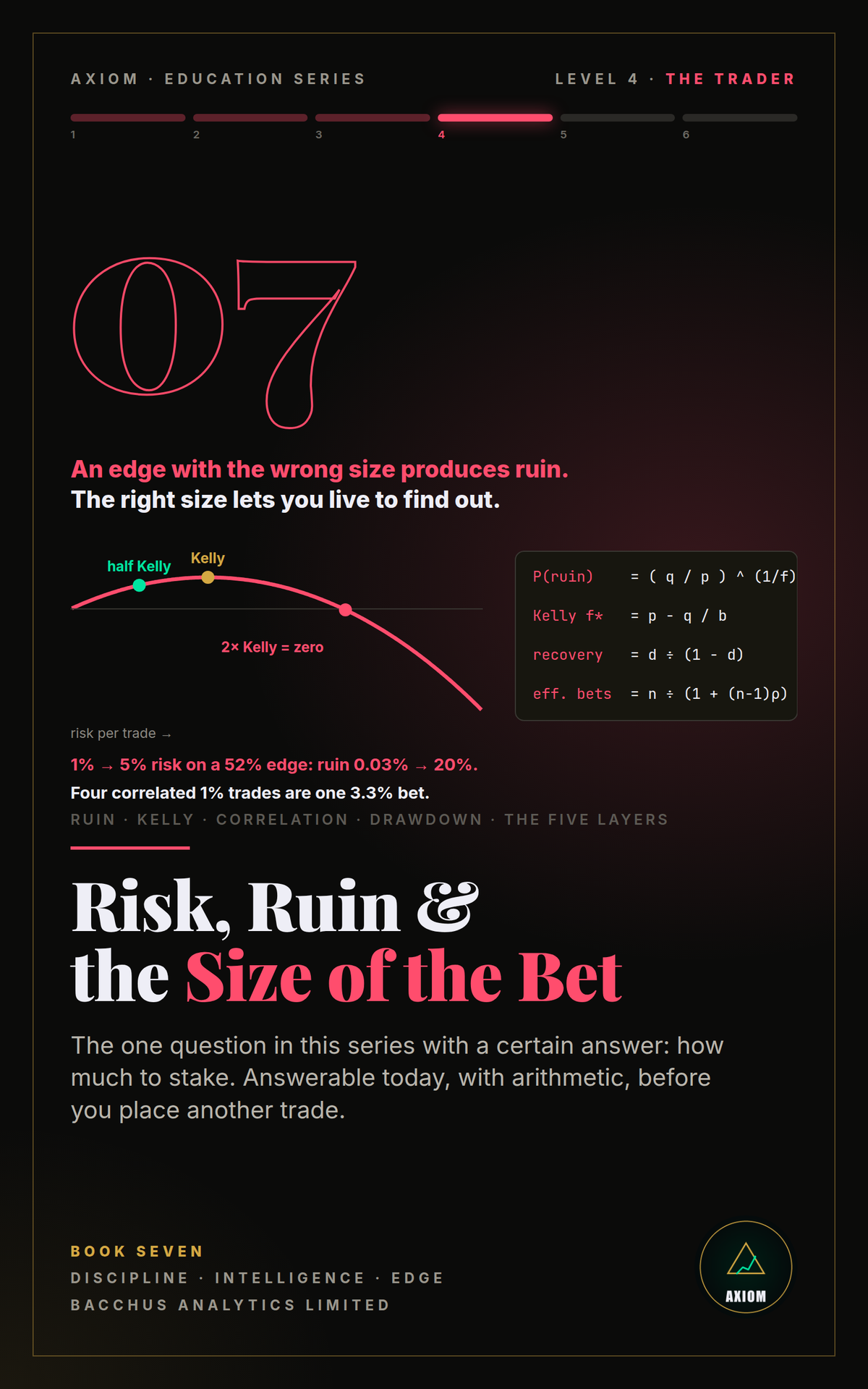
Risk, Ruin & the Size of the Bet — AXIOM Education Series Book 7
LEVEL 4 · THE TRADER · BOOK 7
Books 1 to 6 were about one question: do I have an edge? — answerable only slowly, statistically, and never with confidence. Book 5 said only your own record can settle it. Book 6 said the same.
This book is about the other question, and it has a completely different character. How much should I stake? is answerable today, with arithmetic, before you place another trade — and it depends on nothing but your own decision.
An edge with the wrong size produces ruin. No edge with the right size produces a survivable decline you will notice and stop. If you can only get one of the two questions right, get this one right.
- Why percentages do not average — +50% then −50% is not break-even, it is a quarter of the account gone, and variance is a cost rather than a discomfort
- The recovery curve: d ÷ (1 − d), and why a 50% drawdown needs about a hundred clean winners at 1%
- When the order of your trades starts to matter — percentage sizing, a drawdown limit, and the largest barrier of all, which is you
- One person over time is not a thousand people at once: the coin game with a positive expected value that reliably sends an individual to zero
- Ruin, computed — P(ruin) = (q/p)^(1/f). On a 52% edge, going from 1% to 5% risk moves ruin from 0.03% to 20%. Risk is an exponent, not a dial
- Kelly, and why nobody trades it — the provably optimal stake is about 20% of the account; half Kelly buys 75% of the growth for a quarter of the variance; twice Kelly earns exactly nothing
- How many bets do you actually have? Four positions correlated at 0.6 are 1.4 bets — four disciplined 1% trades are a single 3.3% bet
- Five layers of limit: per trade, per theme, total open, drawdown steps, and the stop — ten seconds per trade
- One year, twice: same edge, same trades, same order. At 4% the trader is stopped on trade 94 — while still up 28% on the year
- Your own ruin audit — one page of arithmetic on your own numbers
Six full-colour diagrams, a risk card, full notation, a glossary and sources. Every formula is given with its assumptions and its failure mode, and every table was computed from the formula printed beside it. Assumes Books 1 to 6 and nothing else.
Next: Book 8 — the gap between the plan and the person executing it.
Instant PDF download, 93 pages, in colour, readable on phone, tablet or desktop.
Educational purposes only, not trading or financial advice. Most retail CFD accounts lose money; trading leveraged products carries a high risk of losing your money.