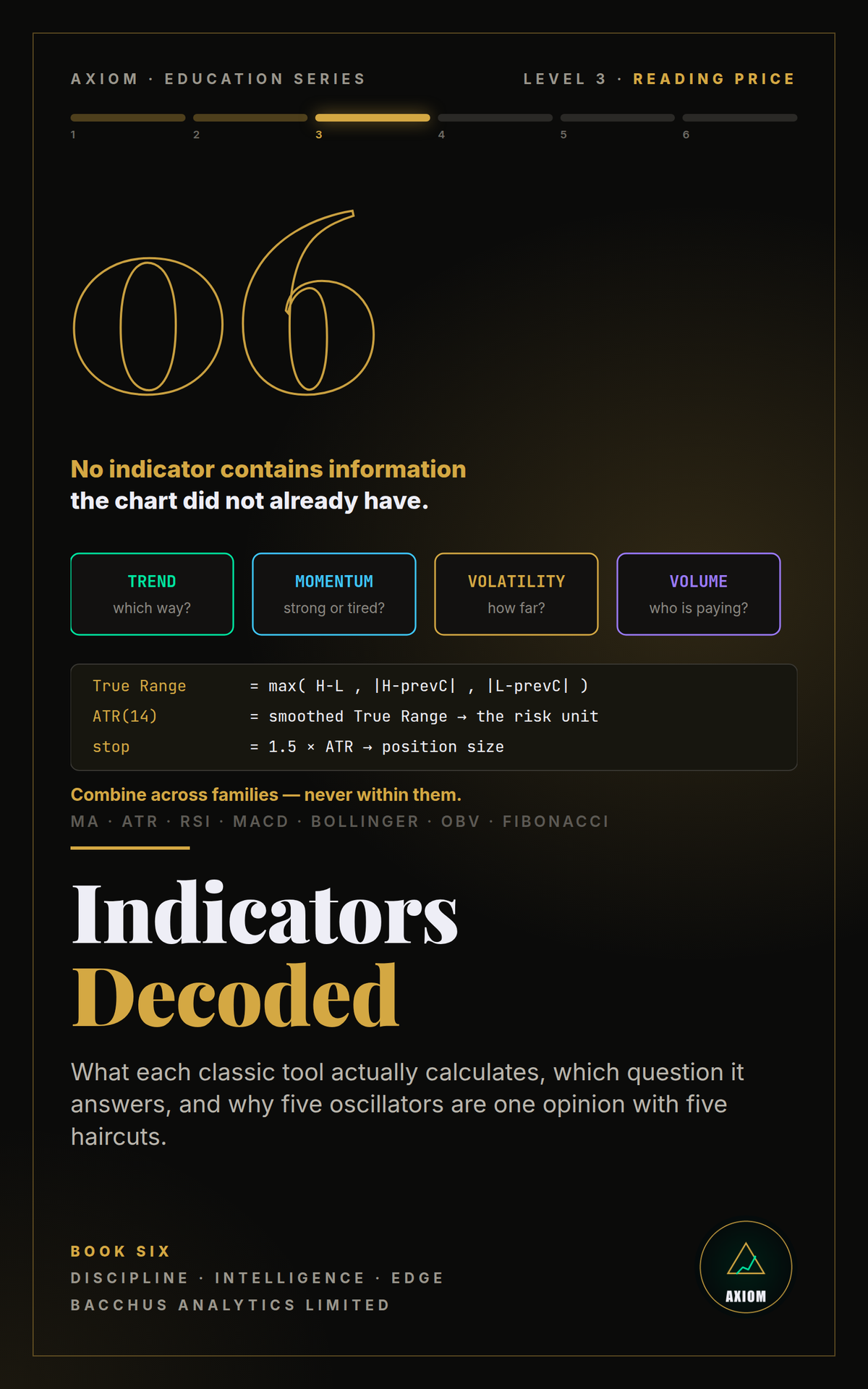
Indicators Decoded — AXIOM Education Series Book 6
LEVEL 3 · READING PRICE · BOOK 6
Picks up exactly where Candlestick Patterns (Book 5) leaves off. Book 5 asked you to judge a candle's size by eye, against its last ten neighbours, and promised a later book would do the same job with a number. This is that book.
The one claim it makes: no indicator contains information the chart did not already have. Every one is a transformation — and knowing which transformation is the difference between using a tool and believing in one.
- Every formula shown in full, so you can rebuild any of them in a spreadsheet and get the same answer
- Four families, four questions — trend, momentum, volatility, volume — and the rule that saves most charts: combine across families, never within them
- The moving average, built by hand: SMA versus EMA, what the period really changes, and why a setting chosen from a backtest is picking the winner after the race
- ATR — the one worth adopting: why True Range takes the largest of three, and the sizing formula that gives you a bigger position in a calm market at identical risk
- RSI and the trouble with "overbought" — why 70 means a strong trend, not an expensive one, and what that misreading costs
- MACD and Bollinger Bands, both built from things you already understand — including the two popular band uses that are exact opposites
- Volume, and the number your FX platform calls volume — OBV, and what tick count can and cannot tell you
- Fibonacci: the mathematics and the mythology — 0.500 is not a Fibonacci ratio, five levels cover half the swing, and self-fulfilment is a real edge if you name it
- One tool per question, a coherent four-part stack, and an honest test with costs included
Five full-colour diagrams, every formula on one page, a printable card, a glossary and sources. Assumes Books 1 to 5 and nothing else.
Next: Level 4 — the other half of every trade: the person making the decisions.
Instant PDF download, 93 pages, in colour, readable on phone, tablet or desktop.
Educational purposes only, not trading or financial advice. Most retail CFD accounts lose money; trading leveraged products carries a high risk of losing your money.